
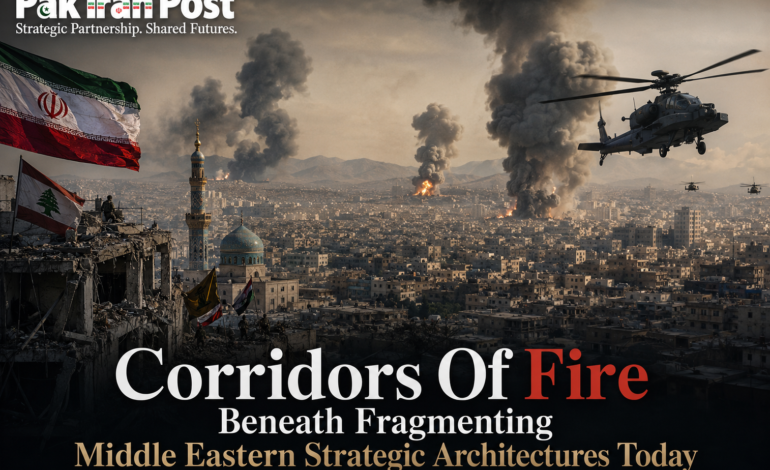
Corridors Of Fire Beneath Fragmenting Middle Eastern Strategic Architectures Today

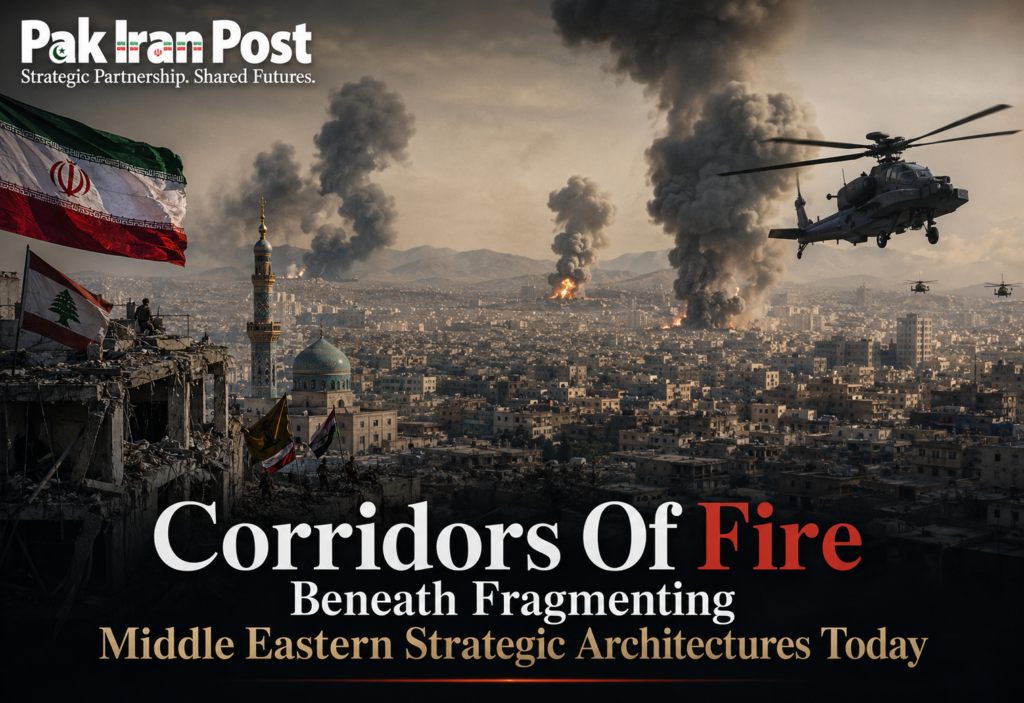
The Middle East is no longer merely a theatre of ideological contestation or sectarian rivalries. It is rapidly transforming into a fragmented security marketplace where states, intelligence networks, private military structures, energy corridors, digital infrastructures, and maritime chokepoints intersect within a highly unstable geopolitical environment. For Pakistan and Iran, this transformation is not peripheral. It is existential. The evolving regional security architecture is quietly redefining the strategic calculations of both states amid intensifying Gulf realignments, maritime competition across the Arabian Sea, fiscal vulnerabilities linked to international financial institutions, and the growing weaponization of connectivity itself.
The old Middle East operated through relatively predictable power equations. Washington maintained military primacy. Gulf monarchies preserved energy leverage. Iran pursued asymmetric deterrence. Pakistan balanced strategic depth with Gulf dependencies. China remained economically present but politically cautious. Russia projected episodic influence. That framework is now eroding under the pressure of economic fragmentation, technological securitization, demographic volatility, climate stress, and shifting energy politics.
A new strategic map is emerging across the region. It is not organized around formal alliances alone, but around flexible tactical convergences. Gulf capitals are simultaneously deepening economic engagement with Beijing, preserving security relations with Washington, opening discreet communication channels with Tehran, and accelerating logistical integration with India. This multidirectional diplomacy reflects a growing realization that the era of singular security guarantors is fading. The consequences for Pakistan and Iran are profound.
Islamabad’s strategic establishment increasingly faces an uncomfortable geopolitical contradiction. Pakistan’s economic survival remains deeply connected to Gulf remittance ecosystems, emergency financial injections, and international lending mechanisms shaped by Western institutional influence. Simultaneously, Pakistan’s western frontier cannot be stabilized without functional strategic coordination with Iran. This dual dependency is producing a delicate balancing doctrine where every regional alignment generates competing costs.
Iran confronts a parallel dilemma. Tehran understands that prolonged regional isolation is economically unsustainable. Yet Iranian strategic thinking remains fundamentally shaped by encirclement anxieties. The expansion of intelligence cooperation between Gulf states, Israel, and Western security actors has intensified Tehran’s perception that the wider region is evolving into a containment architecture designed to gradually restrict Iranian strategic depth. Consequently, Iran increasingly treats maritime access routes, border peripheries, and regional proxy influence as components of regime survival rather than ordinary foreign policy instruments.
This strategic convergence of insecurity is transforming the Arabian Sea into one of the most consequential geopolitical theatres of the coming decade. The waters stretching from Gwadar to the Strait of Hormuz now carry far greater significance than traditional maritime trade alone. They represent energy arteries, intelligence corridors, naval influence zones, digital cable routes, and strategic access points connecting the Gulf to Central Asia and the Indo Pacific.
For Pakistan, Gwadar is no longer merely a commercial port attached to the China Pakistan Economic Corridor. It has become a symbol of competing geopolitical imaginations. Beijing views it as part of a larger logistical architecture reducing dependence on vulnerable maritime chokepoints. Gulf actors perceive it through the prism of regional commercial competition. Western strategic planners quietly evaluate its implications for Chinese maritime penetration into the Arabian Sea. India interprets it within a broader strategic encirclement narrative linked to Chinese regional expansion.
Iran’s Chabahar port exists within a similarly layered geopolitical environment. Although frequently presented as a commercial gateway for regional trade, Chabahar increasingly functions as a strategic instrument through which Tehran attempts to avoid economic suffocation while simultaneously balancing Indian engagement, Chinese influence, and regional isolation pressures. The proximity of Gwadar and Chabahar has therefore created one of the most strategically sensitive maritime spaces in Asia.
Yet the real contest may not be maritime alone. It may emerge from the silent militarization of border geographies. The Pakistan Iran frontier, historically neglected and economically marginalized, is gradually transforming into a highly securitized geopolitical belt vulnerable to insurgency spillovers, narcotics trafficking, demographic manipulation, cyber infiltration, sectarian engineering, and proxy destabilization efforts. Intelligence communities across the region increasingly recognize that destabilized borderlands offer external actors low cost opportunities to pressure rival states without direct confrontation.
This reality is particularly dangerous because the informational environment itself has become weaponized. Media narratives surrounding Pakistan Iran relations are increasingly framed through the lenses of militancy, instability, border violations, sectarian tensions, and proxy suspicion. International coverage often amplifies episodic crises while ignoring deeper structural incentives for cooperation. Such narratives gradually shape investor perceptions, diplomatic confidence, and external policy formulation. Perception itself becomes a strategic battleground.
Meanwhile, economic pressures are intensifying across the wider region. International financial institutions are increasingly linking fiscal stabilization packages with structural energy reforms, taxation adjustments, subsidy withdrawals, and market liberalization frameworks. Pakistan’s ongoing engagement with the International Monetary Fund reflects this broader trend. Energy taxation mechanisms being introduced under fiscal restructuring programs are not merely economic adjustments. They carry deep geopolitical implications.
Rising fuel costs, electricity pricing pressures, and taxation burdens risk generating domestic social volatility precisely at a moment when regional instability is already heightening strategic anxieties. Inflation driven unrest historically creates openings for information warfare, political polarization, and external influence operations. For national security planners, economic fragility can no longer be separated from strategic resilience. The distinction between economic management and national security is disappearing.
Iran faces a different but equally dangerous economic trajectory. Sanctions fatigue, currency depreciation, youth unemployment, and infrastructural stress are producing silent long term pressures on state cohesion. Tehran’s leadership understands that prolonged economic compression weakens strategic sustainability over time, regardless of military deterrence capabilities. Consequently, Iran increasingly seeks alternative economic corridors, regional barter arrangements, and non dollar transactional frameworks to mitigate vulnerability.
China’s growing regional role further complicates these dynamics. Beijing seeks stable connectivity environments for trade expansion, energy access, and technological integration. However, China’s strategic presence also intensifies counterbalancing behaviour from rival powers. As Chinese investments expand across Pakistan and deepen quietly within Iran, external actors increasingly perceive regional infrastructure through the lens of geopolitical competition rather than developmental necessity.
Russia’s evolving Eurasian posture introduces another layer of uncertainty. Moscow’s confrontation with the West has accelerated Russian interest in alternative southern trade corridors connecting Eurasia to warm water access points. Pakistan and Iran occupy critical positions within this strategic geography. Yet greater Russian engagement may also intensify regional competition among external powers seeking influence over transportation routes, energy infrastructures, and security arrangements.
The broader danger confronting both Islamabad and Tehran is strategic overextension amid internal fragility. States operating within volatile geopolitical environments often become consumed by reactive crisis management while neglecting structural resilience. The result is gradual institutional exhaustion. Security establishments become overstretched. Economic systems lose adaptability. Political discourse becomes polarized. External actors exploit fragmentation.
For Pakistan’s strategic community, several policy imperatives are becoming increasingly urgent. First, western border stabilization must evolve beyond purely militarized frameworks. Sustainable security requires integrated economic inclusion, intelligence coordination, digital monitoring capabilities, and infrastructural penetration into neglected peripheral zones. Unmanaged border spaces inevitably become incubators for external manipulation.
Second, Pakistan requires calibrated strategic autonomy. Excessive dependency on any singular geopolitical bloc reduces diplomatic flexibility and increases vulnerability during periods of regional crisis. Islamabad must preserve balanced engagement with Gulf capitals, China, Iran, and Western institutions simultaneously without becoming fully absorbed into competing strategic camps.
Third, energy security must be treated as a national security priority rather than merely an economic sector issue. Reliance on externally vulnerable energy structures exposes Pakistan to cascading fiscal and social instability. Diversified energy partnerships, regional grid integration, and long horizon infrastructural planning are essential.
Iran faces parallel strategic choices. Tehran’s regional posture requires recalibration from permanent confrontation toward controlled strategic flexibility. While deterrence remains central to Iranian doctrine, perpetual securitization risks economic stagnation and regional fatigue. Iran’s long term resilience will depend not solely on asymmetric capability, but on its capacity to normalize selective regional economic engagement without surrendering strategic autonomy.
For both states, maritime cooperation may ultimately become more important than ideological divergence. The Arabian Sea is emerging as a central arena of twenty first century geopolitical competition. States unable to coordinate maritime security, logistical connectivity, cyber resilience, and energy transit governance will face growing vulnerability to external coercion.
The future of Pakistan Iran relations will therefore not be determined merely by bilateral diplomacy. It will be shaped by larger structural transformations sweeping across the Middle East and Eurasia. The collapse of predictable regional orders is creating a geopolitical environment where geography itself is being redefined through corridors, ports, sanctions regimes, intelligence networks, digital infrastructures, and economic dependencies.
Within this evolving order, the greatest strategic danger may not be open conflict. It may be gradual strategic suffocation through economic exhaustion, narrative manipulation, fragmented governance, and externally amplified instability. Modern geopolitical competition increasingly operates below the threshold of declared war. It unfolds through debt pressures, energy shocks, cyber penetration, information operations, demographic stress, and institutional erosion.
For policymakers in Islamabad and Tehran, the central lesson is becoming unavoidable. National security can no longer be understood solely through military equations. Strategic resilience now depends equally upon economic adaptability, informational sovereignty, infrastructural control, demographic stability, and diplomatic flexibility.
The Middle East is entering an age where connectivity and coercion coexist simultaneously. Corridors carry commerce, but also influence. Ports attract investment, but also surveillance. Energy routes generate revenue, but also dependency. Financial assistance stabilizes economies, but also restructures political sovereignty. In this environment, states that fail to anticipate hidden systemic risks may eventually discover that the greatest threats were embedded not within visible confrontations, but within the architectures of interdependence themselves.
A Public Service Message